Sialendoscopic Intraductal Pneumatic Lithotripsy
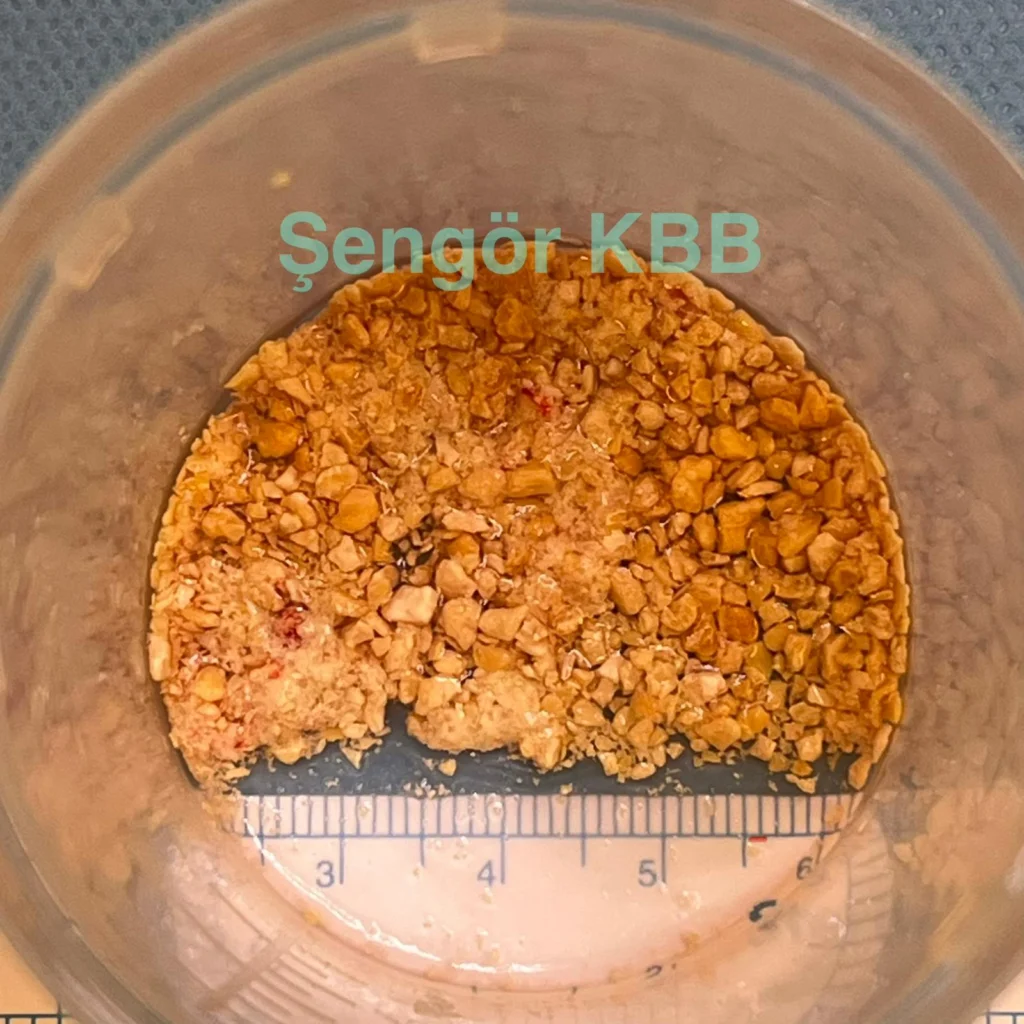
Fragments of a 2 cm intraglandular salivary stone removed by sialendoscopic pneumatic lithotripsy.
Intraductal Pneumatic Lithotripsy for Salivary Gland Stones
Some salivary gland stones are too large or firmly impacted to be removed in one piece. Since 2007, I have used intraductal pneumatic lithotripsy to fragment and remove these stones inside the salivary duct, aiming to preserve both the gland and the natural structure of its duct.
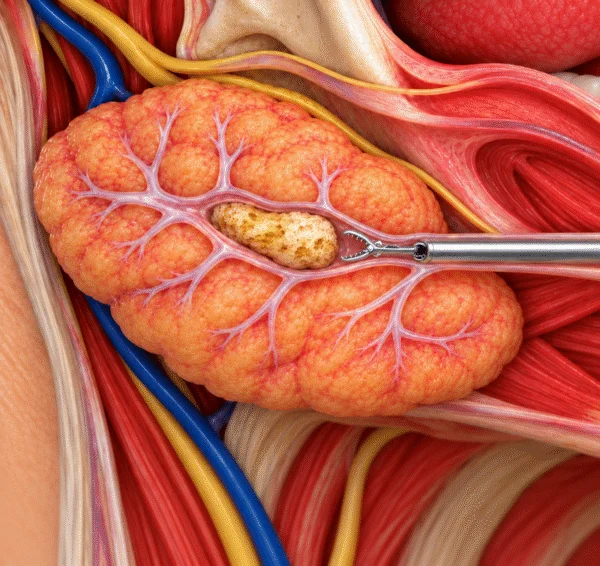
A large salivary gland stone cannot be grasped with forceps, and even if it can be grasped, it cannot be removed through the narrower duct.
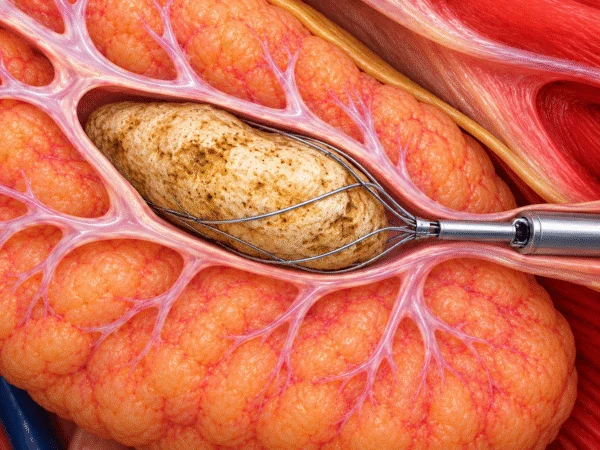
A large stone that, even if grasped with a basket, cannot be pulled through the narrower salivary duct because of its diameter.
Why Do I Fragment Salivary Gland Stones?
The main salivary ducts are approximately 2–3 mm in diameter. Therefore, larger or impacted stones often cannot pass through the duct in one piece. Attempting to pull them out by force may damage the duct.
In approximately 70–75% of my patients undergoing sialendoscopy for salivary stones, fragmentation is necessary to reduce the stone to removable pieces.
My goal is to avoid cutting open the salivary duct or removing the gland whenever possible. Instead, I break the stone into smaller fragments inside the duct and remove them through its natural opening.
This allows me to preserve both the salivary gland and the anatomical integrity of its duct in suitable patients.
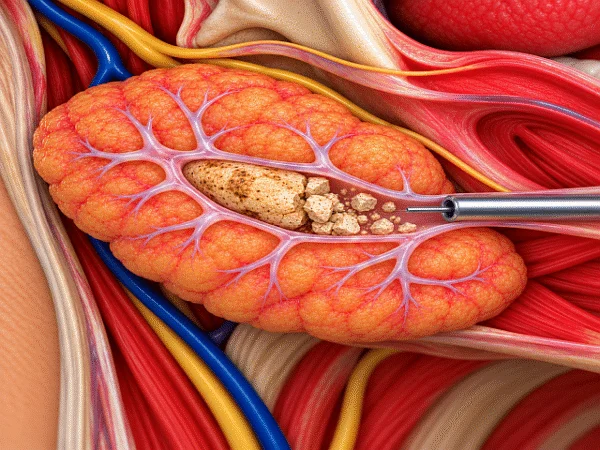
Medical illustration of a large salivary stone being fragmented inside the duct using a pneumatic lithotripsy probe.
Why Do I Prefer Pneumatic Lithotripsy?
In 2007, I adapted pneumatic lithotripsy, a technique used in other medical fields, for sialendoscopic treatment.
Since then, I have fragmented salivary stones inside the duct using controlled mechanical impacts delivered through a very thin probe.
An important characteristic of pneumatic lithotripsy is that it uses mechanical impacts rather than thermal energy to fragment stones.
Laser lithotripsy is another treatment option. However, the heat generated by laser energy requires particular care when working near the delicate tissues of the salivary duct.
With the pneumatic technique I have used for many years, my objective is to fragment stones in a controlled manner while preserving the natural ductal structure as much as possible.
For me, one of its most important advantages is the ability to work for prolonged periods without producing a significant thermal effect.
This allows me to fragment and remove even large or giant salivary stones inside the duct, working patiently and under direct endoscopic vision.
How Do I Fragment and Remove Stones Inside the Duct?
After reaching the stone with the sialendoscope, I advance a 0.6 mm pneumatic lithotripsy probe through the working channel of my 1.6 mm endoscope.
I place the probe tip directly against the stone and deliver controlled mechanical impacts to break it into smaller fragments.
The entire procedure is performed under direct endoscopic visualization.
You can imagine this as working with an extremely small and precise pneumatic hammer inside a delicate duct.
I primarily remove the fragments through the natural duct opening using my irrigation-based flush-out technique.
When necessary, I remove the remaining fragments with delicate forceps.
Because I can observe the fragmentation and removal process directly through the endoscope, I can work carefully to preserve the anatomical structure of the duct.
In this way, even large stones can often be removed as small fragments without cutting open the salivary duct.
This work requires meticulous technique, specialized equipment and considerable experience. It took me approximately ten years to develop and refine this method to the level at which I use it today.
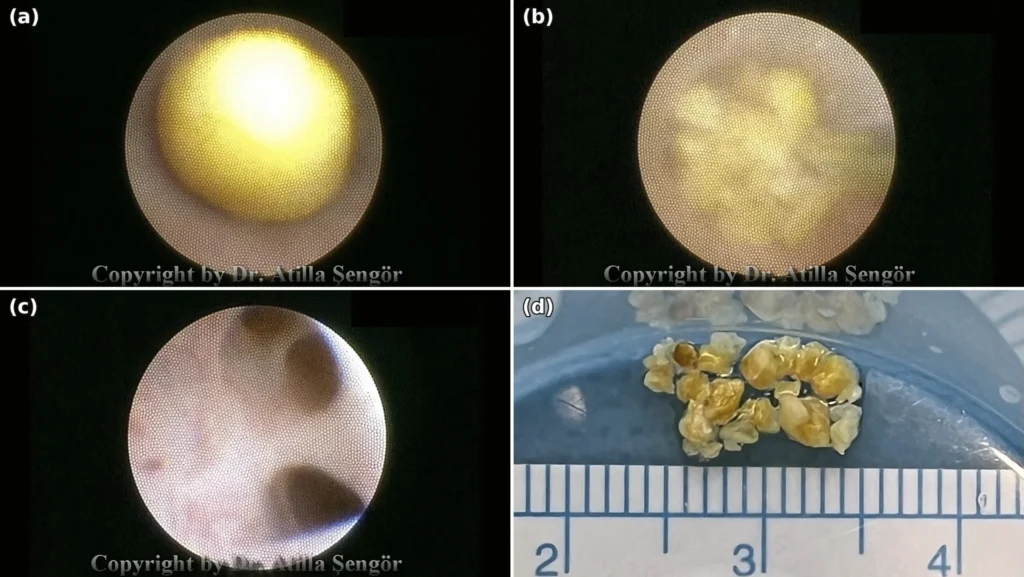
Sialendoscopic treatment of a salivary gland stone using pneumatic lithotripsy: (a) stone inside the duct, (b) intraductal stone fragmentation, (c) cleaned ductal branches after irrigation, and (d) removed stone fragments.
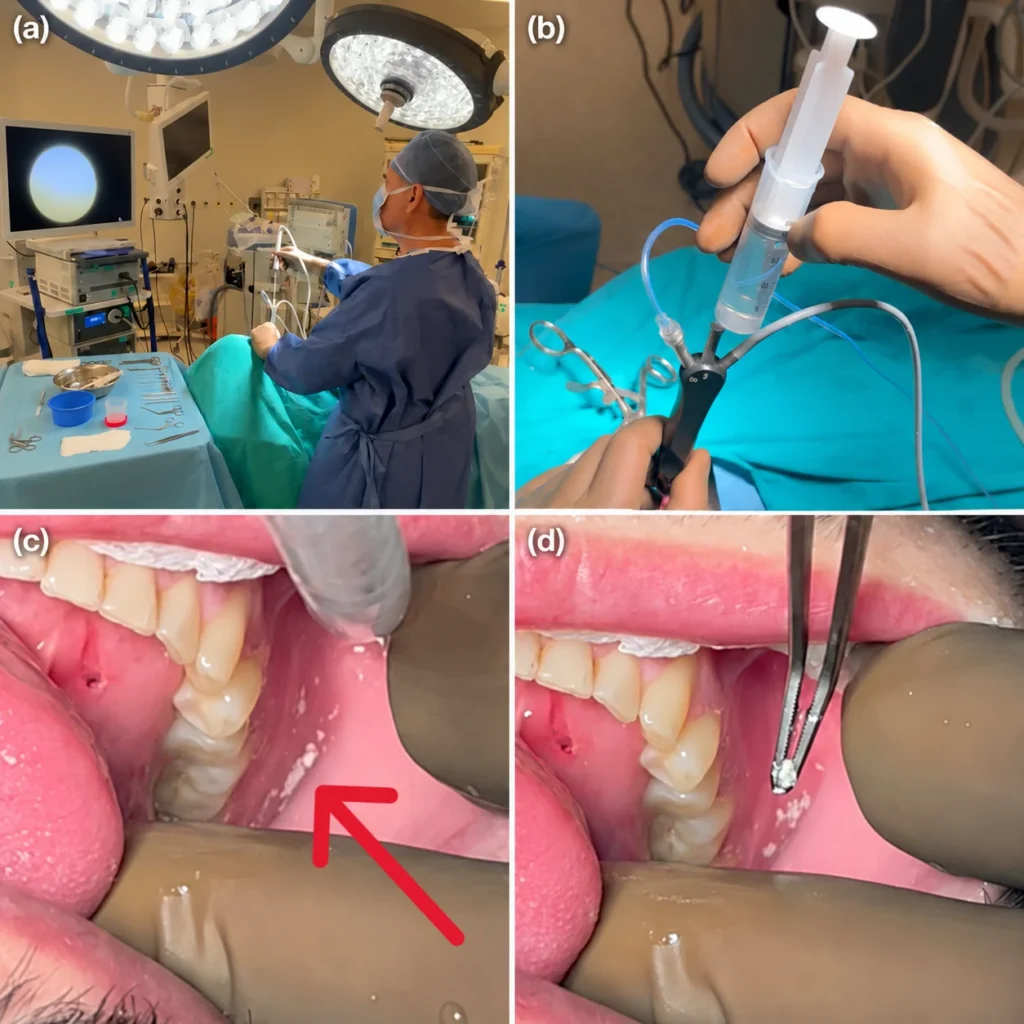
Sialendoscopy and intraductal pneumatic lithotripsy: (a) endoscopic visualization during surgery, (b) irrigation through the sialendoscope, (c) removal of stone fragments through the natural duct opening using the flush-out technique, and (d) collection of the expelled fragments with forceps.
My Results with Large and Giant Salivary Gland Stones
When using pneumatic lithotripsy, the most important factor for me is often not the size of the stone, but whether I can reach it with the endoscope.
Fragmenting large stones may take several hours. However, when a stone is endoscopically accessible, careful and controlled fragmentation may allow me to remove even very large stones while preserving the natural structure of the duct.
In our scientific study published in Annals of Otology, Rhinology & Laryngology in 2022, we treated 111 stones in 84 patients using pneumatic lithotripsy.
We achieved complete removal of 104 of the 111 stones (93.7%). The patient-based success rate was 91.6%. These overall results include subsequent procedures when required.
In a retrospective review of cases treated during the past ten years, I identified 39 giant salivary stones measuring 15 mm or more. Complete removal was achieved in 37 of these 39 stones (94.9%).
These results demonstrate that stone size alone does not necessarily prevent successful intraductal treatment in appropriately selected patients.
Nevertheless, removing some large stones requires prolonged operating time and occasionally a second treatment session. I discuss these possibilities with my patients before treatment.
Read my scientific publication on PubMed
Real Surgical Videos and Images
The following videos show how I fragment salivary gland stones of different sizes using sialendoscopy and intraductal pneumatic lithotripsy.
All recordings are from my own surgical procedures.
For additional surgical images and examples of different cases, please visit my Sialendoscopy Case Examples page.
Real Surgical Videos